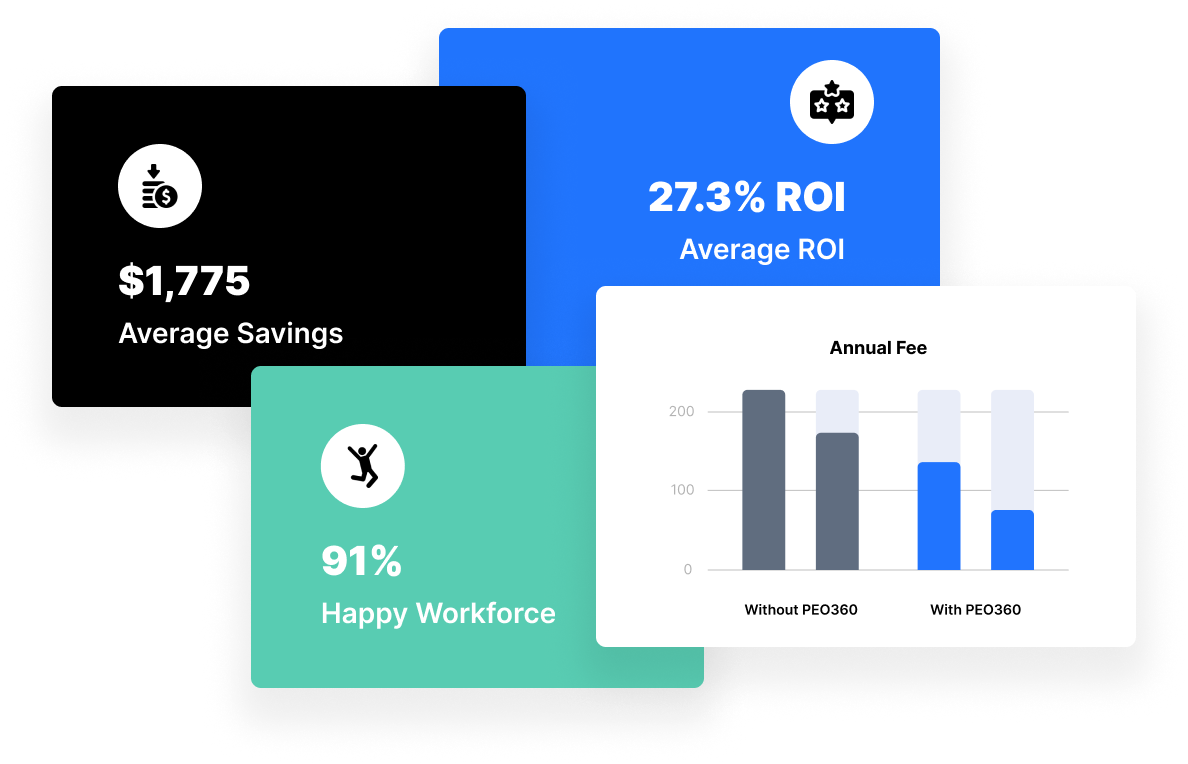

One of the biggest hurdles businesses face when looking into PEOs is getting an accurate cost comparison. At first, it might seem straightforward: gather a few proposals, compare the totals and major line items, and go with the one that costs less. In reality, a PEO’s total price can depend on a dozen or more variables. On top of that, some PEOs bundle certain expenses while others charge separately, and even two companies with similar headcounts can receive very different quotes based on how their workforce is underwritten.
To get a truly accurate comparison, you have to look much deeper than the bottom-line number. Leadership needs to understand what drives each proposal, whether the plans and services are directly comparable, and what the business is likely to pay over the course of the year. Only then can you determine which PEO actually offers the best fit and value for the company.
In this article, we’ll break down the biggest PEO cost drivers, explain why pricing can vary so much, and show you how to make a more accurate comparison before choosing a provider.
What You Should Know Before Comparing PEO Costs
Before getting into the individual cost drivers, it helps to understand how the numbers are calculated and what services and benefits you’re actually getting for the price. A useful PEO cost comparison should help you see beyond the quoted total and understand what each option really represents.
As you review PEO proposals, pay close attention to:
- How each cost is calculated. Some PEOs use flat per-employee fees, while others base certain costs on payroll or another pricing structure.
- What assumptions are built into the proposal. Headcount, payroll, bonuses, commissions, insurance participation, and other projections can all affect the estimated annual cost.
- Whether the plans and services are directly comparable. Two health plans or service packages may look similar at a glance but differ in ways that significantly affect cost or value.
- What is included in the quoted price. Technology, administrative services, and other tools may be bundled with one provider and charged separately by another.
- What your business is likely to pay over a full year. A useful comparison should reflect how your company actually operates, not just the initial figures presented in the proposal.
- What you receive for the cost. Technology, HR support, service levels, and the overall employee experience can all influence whether a higher-priced option ultimately provides greater value.
With that context in mind, the next step is understanding the individual factors that have the greatest impact on PEO pricing.
What Actually Drives the Cost of a PEO?
PEO pricing often includes a long list of services and expenses, but a few categories tend to have the greatest impact on the total cost. While every arrangement is customized to the business, these are the areas leadership should pay particularly close attention to when reviewing a proposal.
Health Insurance
For many businesses, health insurance is one of the largest line items in a PEO proposal and one of the biggest factors in the final decision.
Because of differences in underwriting, plan design, workforce demographics, participation, employer contributions, and other factors, pricing can vary significantly. This is also why two companies with similar headcounts can receive very different quotes. Each group is evaluated individually, and the results can range from highly competitive rates to situations where a provider declines to offer coverage altogether.
The plan itself matters, too. Two options may have similar premiums but very different deductibles, networks, coverage levels, or employee costs. An accurate PEO cost comparison needs to account for both the price of the insurance and what employees are actually receiving.
Administrative Fees
Administrative fees are another major component of a PEO proposal. These fees cover many of the core services a PEO provides, including payroll, HR administration, compliance support, and benefits administration.
Most PEOs charge these fees on a per-employee, per-month basis, although some use a percentage of gross payroll or another pricing structure. With per-employee pricing, it’s important to note that the rate may decrease as headcount grows. With a percentage-of-payroll model, on the other hand, bonuses, commissions, raises, and other changes in compensation can all increase what the business ultimately pays.
That means administrative fees should be compared based on what the business is likely to pay over the full year, not just the rate shown in the proposal.
Worker’s Compensation
Workers’ compensation may represent a relatively small portion of the total cost for a low-risk, primarily white-collar workforce. For businesses in construction, manufacturing, and other higher-risk industries, however, it can become a much more significant expense.
That makes the underlying classifications, payroll figures, and rates especially important when comparing proposals. Even a modest percentage difference can translate into meaningful savings when workers’ comp premiums are high.
State Unemployment Taxes
State unemployment insurance taxes are not always a major factor in a PEO decision, but they can create significant cost differences in certain situations.
Depending on the state and reporting structure, the rate applied to the business may vary. Transition timing can matter as well, particularly when a company is moving into or out of a PEO relationship during the year.
These costs are often less visible than health insurance or administrative fees, but they should still be accounted for before leadership compares the total price of two options.
Technology and Additional Services
A PEO proposal can also include a wide range of technology and HR services. Depending on the provider, these may be included in the standard administrative fee or charged separately.
Examples can include:
- Time, attendance, and leave management
- Recruiting and applicant tracking
- Performance, learning, and compensation tools
- Expense management
- ACA reporting, compliance, and training resources
These individual fees may not seem large on their own, but they can add up. More importantly, a service included with one PEO may require an additional charge with another, which can make the proposals look more similar than they really are. That’s why it’s important to look closely at what each quoted price actually includes.
Ancillary Benefits and Programs
Other benefits and programs may also affect the overall package, including 401(k) plans, FSAs, HSAs, dental and vision coverage, disability and life insurance, employee assistance programs, and telehealth services.
These items are less likely to drive the decision than health insurance or administrative fees, but they can still contribute to the overall value of the PEO. In some cases, access to larger-group programs or services through the PEO may also reduce costs the employer would otherwise incur separately.
The key is not to treat every line item equally. Health insurance, administrative fees, workers’ compensation, and state unemployment taxes tend to create the greatest pricing differences, while technology and additional services often determine how much value the business receives for that price.
How to Get an Accurate PEO Cost Comparison
Step 1: Convert Administrative Fees to a Comparable Annual Cost
Start by determining how each PEO calculates its administrative fees. If one provider charges per employee and another charges a percentage of payroll, the rates themselves will not give you a useful comparison.
Estimate what each structure will cost over a full year based on realistic headcount and payroll projections. For percentage-based fees, that should include expected bonuses, commissions, raises, and other compensation that may affect the final amount.
Step 2: Compare Equivalent Health Plans
A lower health insurance premium does not necessarily mean lower-cost or equivalent coverage. Compare the plan itself alongside the price, including:
- Deductibles and out-of-pocket costs
- Provider networks
- Copays and coinsurance
- Coverage tiers
- Employer and employee contributions
These details can reveal meaningful differences between plans that appear similarly priced on the surface.
Step 3: Review Workers’ Compensation Costs
Make sure each proposal uses accurate workers’ compensation classifications, payroll figures, and rates for your business. This becomes particularly important if you’re in an industry where workers’ compensation represents a significant portion of overall PEO costs.
If one proposal uses different classifications, payroll estimates, or rates than another, find out why before comparing the totals. Otherwise, the apparent cost difference may be coming from the way the proposals were calculated rather than the PEO’s actual pricing.
Step 4: Account for Taxes and Transition Timing
State unemployment taxes can also affect the total cost, particularly when a company is transitioning into, out of, or between PEOs. Review how each provider is calculating these taxes and whether the timing of the transition could affect what the business pays. Depending on the situation, the provider’s CPEO status and the way payroll taxes are handled during the transition may also warrant closer review.
Step 5: Identify What’s Included and What Costs Extra
Look beyond the major line items and determine exactly what each PEO includes in its standard pricing. One provider may include technology, employee access, FSA or HSA administration, timekeeping, or other services that another charges for separately. Accounting for these differences helps prevent a lower initial quote from becoming more expensive once additional fees are added.
Step 6: Build the Full Annual Cost
Once you’ve reviewed each major line item, add them together based on realistic expectations for the year ahead. Include administrative fees, health insurance, workers’ compensation, taxes, and any additional services or fees your business expects to use.
Only then should you compare the final totals. If the proposals are based on different coverage, assumptions, or included services, the quoted numbers alone can give you a misleading picture of which PEO actually costs less.
Beyond the Quote: The Soft Cost (or Value) of a PEO
Once you’ve compared the direct costs, there’s still one more thing to consider: what each PEO will require from your business after implementation.
The best PEO relationships can reduce the amount of time and resources your team spends managing HR. Payroll, benefits administration, compliance support, technology, and other functions may be consolidated through one provider instead of spread across multiple vendors, systems, and internal owners. On the other hand, a lower-priced PEO may leave gaps that your business has to fill elsewhere.
When comparing providers, consider:
- Internal time and workload. How much will your team still need to manage directly?
- Additional vendors and technology. Will you need separate software or outside partners to supplement the PEO?
- HR resources. What level of expertise and support will be available when your team needs help?
- Vendor management. How many separate contracts, renewals, and relationships will your business still need to oversee?
- Employee experience. How easy will it be for employees to access payroll, benefits, and HR support?
These factors may not appear as line items in the proposal, but they can still have real financial and operational value. A more expensive PEO may reduce workload and eliminate other costs, while a lower-priced option may require additional time, software, or outside support. That’s why it’s important to define what you want your PEO to provide — not just what you want it to cost.
Get a Clearer PEO Cost Comparison with PEO 360
When it comes to PEO cost comparisons, the lowest quote isn’t always the least expensive option. And a higher price doesn’t automatically mean you’re overpaying. What matters is what your business will actually spend and what you’re getting in return.
PEO 360 helps businesses dig into those details. We compare pricing structures, health plans, workers’ compensation, taxes, included services, technology, HR support, and other factors that can change the real cost and value of a PEO.
Just as importantly, we’re not trying to steer you toward a particular provider. As an independent advisor, our job is to help you understand where the meaningful differences are, what tradeoffs come with each option, and which PEO makes the most sense for your business.
Whether you’re looking at PEOs for the first time or wondering how your current provider stacks up, we can help you get a clearer picture before you make a decision. Connect with our team today to compare your options.